What if we tried something different?
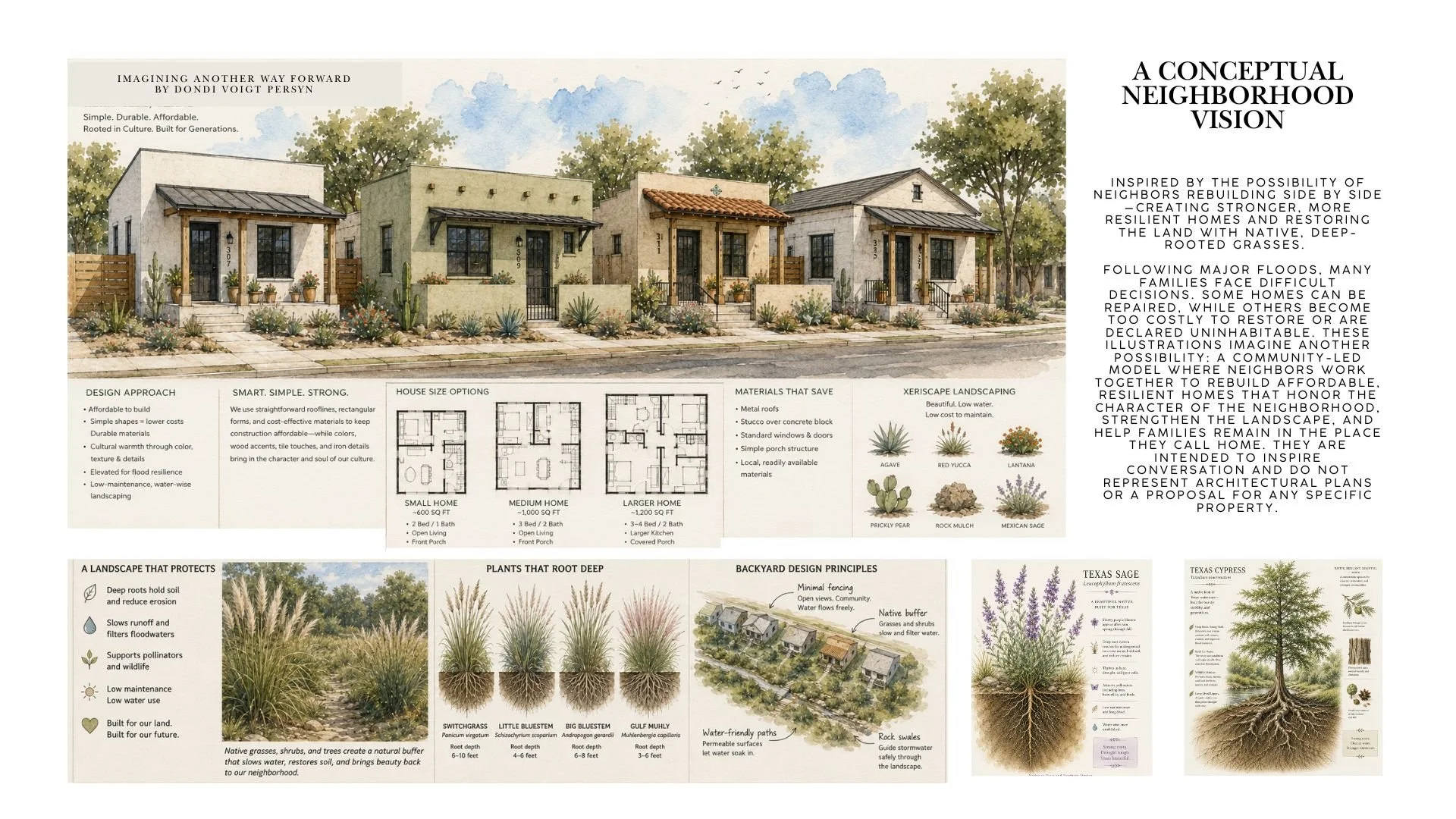
by Dondi Voigt Persyn
I’m not a home builder.
I’m not an architect.
I’m not a developer.
What I am is a problem solver.
Over the past several weeks, I’ve been stationed just a few streets away from one of the neighborhoods hardest hit by the flood. I’ve walked through living rooms still covered in mud. I’ve helped muck out homes. I’ve talked with homeowners, tenants, volunteers, and neighbors. I’ve watched people trying to figure out how to put their lives back together.
And I keep coming back to the same thought.
What if there was another way?
Across the country, we’ve seen what often happens after disasters like this. Some homes are repaired. Some become too costly to restore. Some families relocate because rebuilding simply isn’t possible for them. Over time, neighborhoods change, and communities that have existed for generations can begin to disappear.
I’d hate to see that happen here.
So I’ve been doing what I naturally do: thinking, sketching, asking questions, and imagining possibilities.
What if an entire neighborhood rebuilt together instead of one house at a time?
What if thirty homeowners shared a common vision, a handful of thoughtfully designed plans, and purchased materials together instead of separately?
What if simple, beautiful concrete block homes could be built for under $100,000 each through standardized designs, bulk purchasing, and significant donated labor?
What if those homes were elevated above future flood levels, designed to recover more easily after extreme weather, and surrounded by native landscapes that worked with the land instead of against it?
What if the riparian areas were restored with deep-rooted native grasses, trees, and vegetation that slow runoff, stabilize soil, and improve the health of the watershed?
What if recovery became an opportunity to build something stronger than what existed before?
I’m not suggesting I have all the answers.
I don’t.
These sketches and illustrations are simply a thought experiment—a conceptual vision meant to spark conversation. They are not architectural plans or a proposal for any specific property.
But I can’t help wondering…
Could a neighborhood become a national model for mindful disaster recovery?
Could we demonstrate that recovery doesn’t have to mean displacement?
Could we show that rebuilding can be beautiful, affordable, resilient, and community-driven?
Based on the preliminary numbers I’ve been exploring, I believe a neighborhood of roughly thirty homes could potentially be rebuilt for somewhere in the range of $3 million to $5 million, depending on site conditions, donated labor, engineering requirements, infrastructure, and final design. Those figures would need to be refined by architects, engineers, contractors, and the families involved, but they suggest that this idea may be more attainable than many people imagine.
Maybe someone reads this who knows how to make an idea like this possible.
Maybe it’s philanthropists.
Maybe it’s builders.
Maybe it’s engineers.
Maybe it’s a foundation.
Maybe it’s neighbors themselves.
I don’t know.
I only know that every meaningful change begins with someone asking, “What if?”
So I’m putting this idea into the universe.
Not because I know exactly how it should happen.
But because I believe there may be another way.
And if that way helps families remain in the neighborhoods they love, protects the character of the community, and creates a model that other flood-affected towns can learn from, then I think it’s an idea worth exploring.
Sometimes the first step toward rebuilding a neighborhood isn’t pouring concrete.
Sometimes it’s giving people permission to imagine a different future.